





20.03.2026 | Walter Willisch and Christian Noti are monitoring the Mattmark Dam
Working on a structure that lives
Dam keepers Walter Willisch and Christian Noti are out and about high up on the Mattmark Dam, whatever the weather. They measure and monitor every movement of Europe’s largest earth dam – down to the millimetre.
At just under 2,200 metres above sea level, on the crest of the Mattmark Dam, a mild southerly breeze blows, sweeping in from the Mediterranean across the high Alpine landscape. All around, four-thousand-metre peaks soar into the sky: from the Weissmies to the glacier-covered mountains of the Monte Rosa range. The Mattmark Dam is situated at the southern end of the Saas Valley in Valais, near the border with Italy. It is the largest earth and rock-fill dam in Europe. Like a mighty rampart, it stretches across the valley.
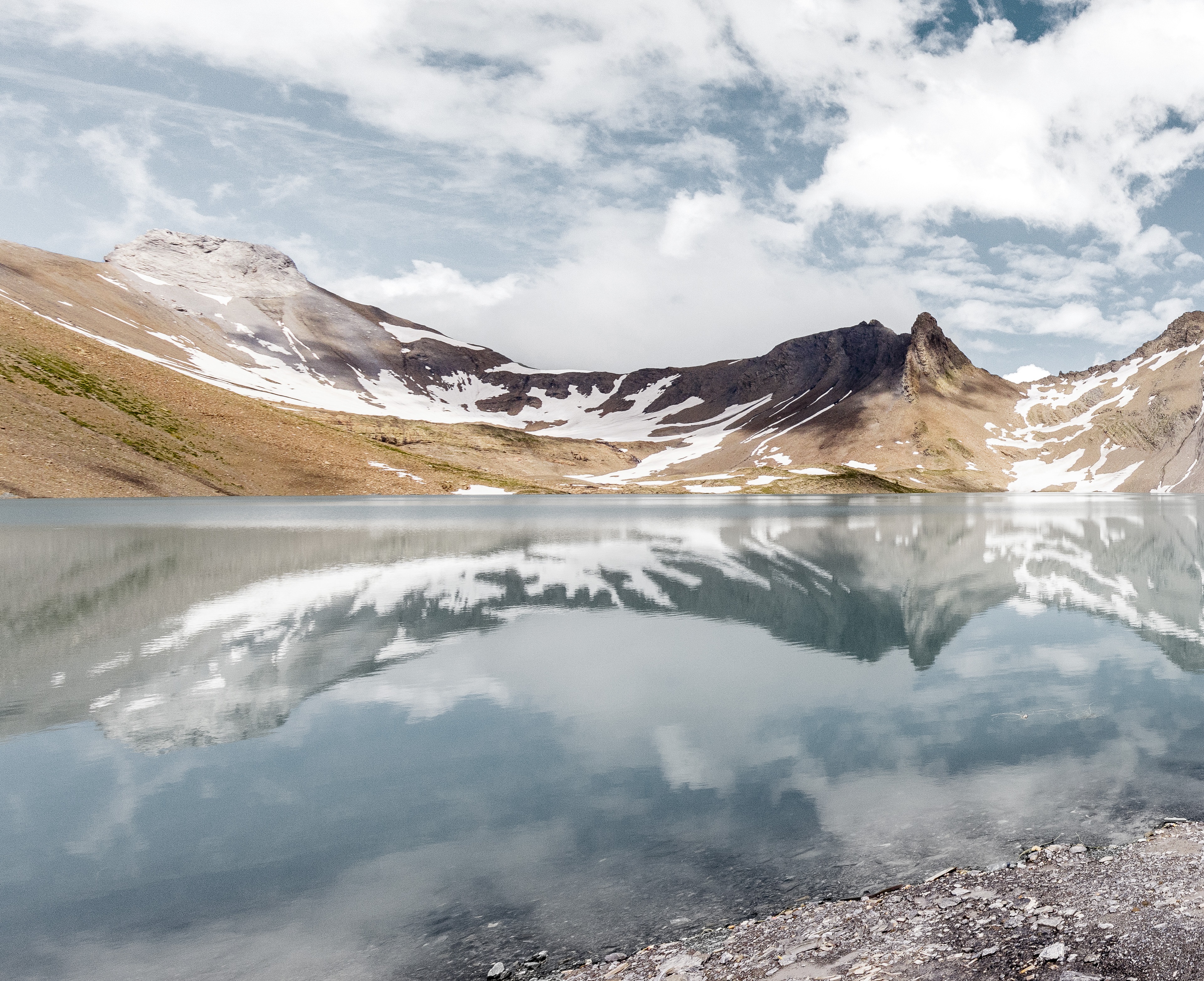
The dam is around 120 metres high and almost 800 metres long. It holds back 100 million cubic metres of water. The lake is fed by glacial and tributary streams from the catchment area around the Allal glacier. The lake’s surface, spanning almost two square kilometres, is still covered in ice. However, the first cracks are appearing along the banks – harbingers of spring.
Working where others go on holiday
A dam like Mattmark is not a static structure. It works. It moves, reacts to temperature, water pressure and the seasons – and is constantly monitored, particularly under the watchful eyes of Walter Willisch and Christian Noti. “Our very first task is to monitor the dam body,” Noti sums up succinctly.
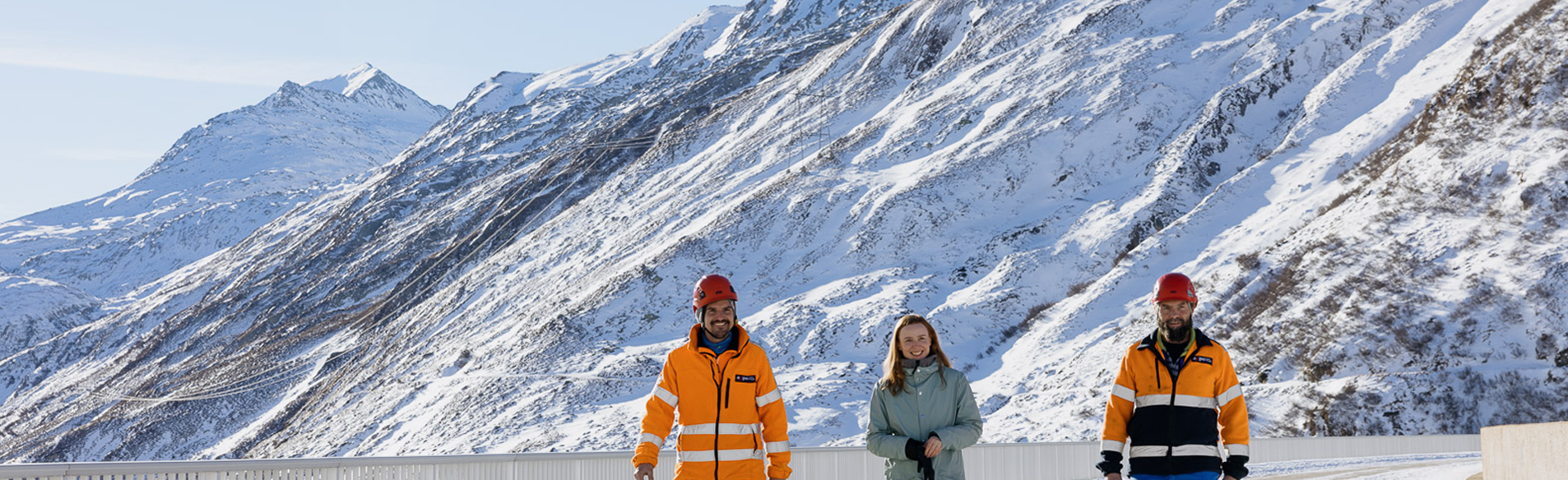
The two dam wardens set off early in the morning from the Zermeiggern power station. In winter, the access road to the dam is closed. The only way up is by snow groomer. The journey takes them through a quiet, enchanting winter landscape. Encounters with golden eagles are not uncommon here. Willisch says he has even spotted the rare bearded vulture. “We work where others go on holiday,” he says with a laugh.
“Every day is different”
They are a well-established team who have known each other since their youth. Both are from the valley. Willisch, a trained bricklayer, brings many years of practical experience as a foreman on construction sites. Noti, originally a lorry mechanic, gets the odd motor running again. As dam keepers, they have found their calling, even if the work is demanding. Anyone who isn’t fit is out of place here.
As well as an understanding of technology and manual dexterity, knowledge of hydrology, geology and measurement technology is part of the job. “You need to know a bit about everything. And it takes five to seven years before you really get to know the power station,” says Noti. Repairing pipes, servicing pumps and measuring equipment, cleaning fittings, operating steel gates weighing tonnes, or analysing measurement data: it’s an all-round job. What needs to be done is planned week by week. “Every day is different,” says Willisch.
Precision measurements
The two men drive slowly in the Pistenbully across the wide, snow-covered crest of the dam. Their destination: a concrete pier on the lake side. In their luggage: a high-precision laser measuring device and reflectors. The instruments are used to carry out regular geodetic surveys of the dam – a check that reveals even the slightest changes.
They secure the theodolite – as the measuring instrument is known in technical jargon – to the pier and carefully align it. First, the device targets a distant reference point on the rock. Only once the digital orientation is established does it swing back towards the dam and lock onto the reflector. Step by step, the entire crest is thus measured with millimetre precision.
Willisch and Noti also periodically check the levelling between fixed points on the valley flanks. Using a precision levelling instrument, height differences are measured across several measurement points distributed along the dam crest. Even the slightest changes reveal how the dam behaves under variable loads.
So simple, so elegant
Among the most important safety checks are seepage water and pore pressure measurements. These show how high the pore water pressure is within the dam and where the so-called seepage line runs. Manual inspection is precise and simple – and that is precisely why it is so elegant: measuring tubes, known as piezometers, are embedded in the dam body. Willisch lets a measuring tape slide down from a reel. An electrical probe is attached to the end of the tape. When it reaches the seepage line, the circuit closes and a signal sounds. Metre by metre, the tape disappears into the tube until the signal sounds. The measured value is recorded digitally in the system via a tablet, just like all other data.
It is not only the dam itself that is monitored, but also the catchment area. Rainfall collectors (totalisers) are situated around the lake at an altitude of almost 3,000 metres. Rain and snow accumulate in the funnels over months. A salt solution prevents freezing, whilst a layer of oil prevents evaporation. The stations are visited twice a year and the rainfall amounts are recorded. The measured amounts are later analysed at the Laboratory of Hydraulics, Hydrology and Glaciology (VAW) at ETH Zurich and by MeteoSwiss.
1,000 steps
A comprehensive inspection tour of the facility takes three days. The tunnel system alone comprises over a thousand steps; the longest access tunnel has 440 steps. Water drips from the ceiling in the tunnels. The air smells of damp rock. Cable trays and pipes run along the walls.
Drainage systems collect seepage water – water that has found its way through the dam body. “That’s completely normal. But if the readings change, we take a closer look,” explains Willisch. The water drains away through an open channel in the drainage tunnel.
To seal the dam’s subsoil, a vertical injection screen (sealing screen) was installed beneath the dam core, extending down to the impermeable rock.
When the water rises
A dam must not overflow. The lake serves as a buffer. Water can be discharged in a controlled manner via the bottom and middle outlets if necessary. Massive gates and flaps open the waterway or shut it off completely. In extreme cases, the flood relief system ensures that large volumes of water can be safely discharged downstream via the flood relief tunnel.
In the event of a power cut, a diesel-powered emergency generator is on standby to keep the most critical systems running for several days. In the event of a network failure, the facility also has redundant communication systems. The dam keepers thus remain connected to the control centre at all times.
Monitoring is geared towards all eventualities and, as with any dam, strictly regulated – from the federal supervisory authority through technical experts and engineers to the safety concepts of the power plant operators. For this system to function, it requires people on site such as Walter Willisch and Christian Noti. Staying calm, communicating clearly, acting with composure even in difficult situations – qualities that set the two of them apart. They are a central part of a finely tuned safety framework that monitors the Mattmark dam around the clock.
Mattmark Power Station – Facts and Figures
The Mattmark power station at the end of the Saas Valley (VS) is one of Switzerland’s most important high-pressure hydroelectric power stations. The imposing earth-fill dam with its central sealing core is the heart of the plant.
- Height: 120 m
- Crown length: 780 m
- Reservoir volume: approx. 100 million m³
- Reservoir catchment area: 88 km2 including water intakes, of which around 45% is glaciated
- Total catchment area: 162 km2
A ten-metre raising of the dam is currently being assessed. This would significantly increase the storage volume and provide around 60 gigawatt-hours of additional winter electricity.
The dam is equipped with high-performance safety systems: the flood discharge can release up to 230 cubic metres of water per second, the intermediate discharge 42 cubic metres per second and the bottom discharge 57 cubic metres per second. In addition, a flood retention volume of around 3.6 million cubic metres is available.
The power station’s average annual electricity production is around 613 million kilowatt-hours, more than half of which is generated during the winter months. The water is used in two stages for electricity generation: at the Zermeiggern power station below the dam, Francis turbines drive generators with an installed capacity of 74 megawatts (MW). If required, water can be pumped back up to Lake Mattmark from there via two large pumps. From Zermeiggern, the water continues to the Stalden power station, where it flows through high-pressure pipes to Pelton turbines with an installed capacity of 186 megawatts.
Kraftwerke Mattmark AG is managed by Axpo.


