







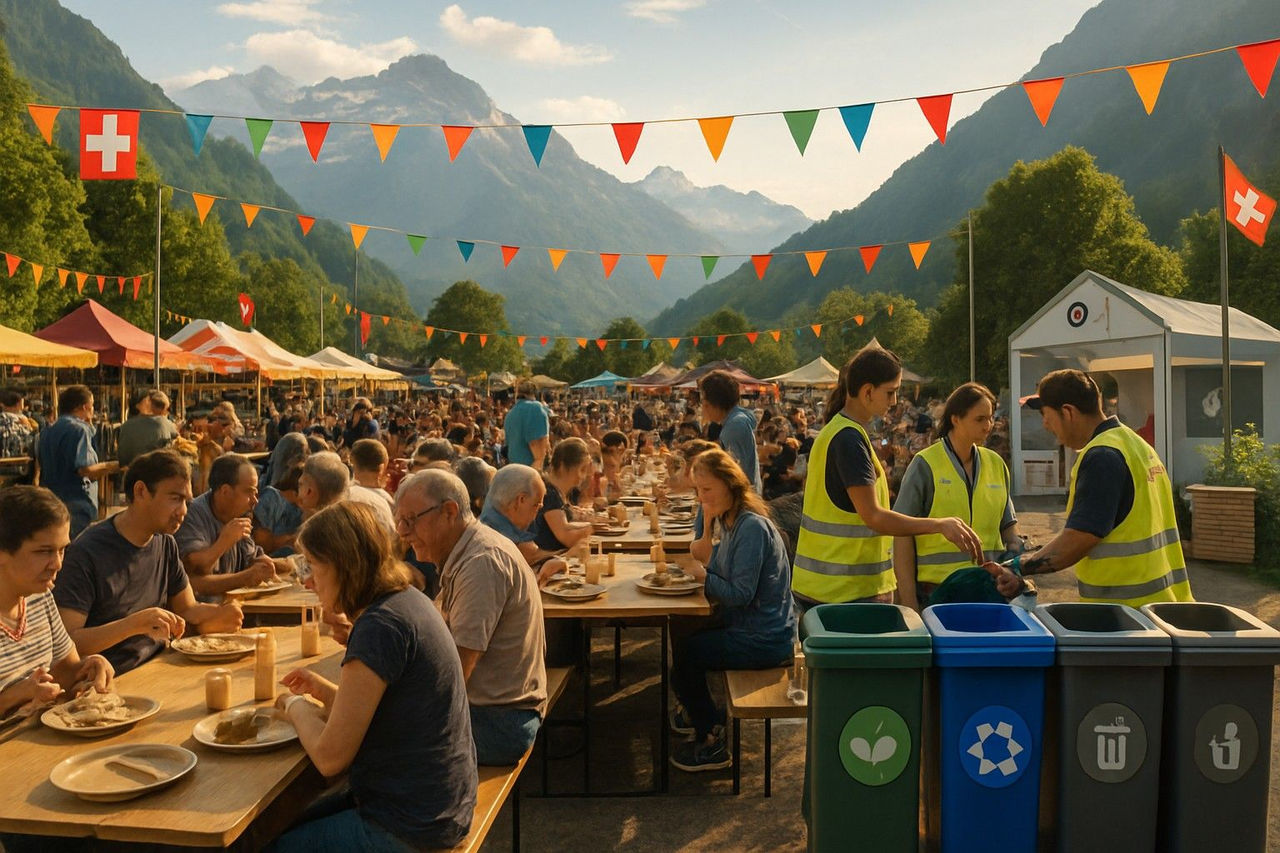
10.11.2025 | Axpo Biomasse offers a practical and sustainable waste disposal solution for event organisers
Biodegradable tableware instead of mountains of waste
More and more restaurants, caterers and event organisers are turning to biodegradable tableware. But what to do with it after the event? This is where Axpo Biomasse comes in, offering a simple, reliable and sustainable disposal solution from a single source.
It's not uncommon for parties to be followed by a hangover: mountains of waste pile up and disposal becomes a headache. This doesn't have to be the case if organisers use compostable tableware. That's why more restaurants, caterers and event organisers are turning to biodegradable plates, bowls and other tableware. Several well-known organisers already use Axpo Biomasse's disposal solution. These include Zurich Zoo, vegetarian pioneer Hiltl and, from spring 2026, Zurich's Hallenstadion.
All services from a single source
In various cantons, the use of reusable or compostable tableware is already mandatory for larger events. Appropriate disposal is required for approval. Axpo Biomasse accepts compostable tableware – together with food waste and other biogenic waste. This means one collection point, one process and one clear solution. Event organisers save time, reduce complexity and strengthen customer loyalty.
Compostable tableware is more than just a trend. It is an important element of a modern circular economy. With its services, Axpo Biomasse enables low-waste events and practical handling of organic material flows. This conserves resources, reduces emissions and sets a visible example for sustainability – from the plate to energy production.
How the circular economy works
Compostable tableware and biogenic waste are converted into biogas, electricity and biogas and heat in one of Axpo Biomasse's 15 dry fermentation plants. In addition, after the fermentation process, around 900 kilograms of nutrient-rich natural fertiliser in solid and liquid form remain from one tonne of organic waste. This is used both on agricultural fields and in gardens, thus closing the natural recycling cycle of biomass.
Axpo Biomasse Axpo Biomasse AG recycles around 280,000 tonnes of biomass per year in its 15 fermentation plants and six composting sites. The organic waste is used to produce biogas, electricity, heat, natural fertiliser and compost. Axpo Biomasse AG produces a total of around 75 GWh of energy per year, which corresponds to the energy consumption of around 17,000 households. More information
Axpo Biomasse
Axpo Biomasse AG recycles around 280,000 tonnes of biomass per year in its 15 fermentation plants and six composting sites. The organic waste is used to produce biogas, electricity, heat, natural fertiliser and compost. Axpo Biomasse AG produces a total of around 75 GWh of energy per year, which corresponds to the energy consumption of around 17,000 households.


