




Axpo Energy Reports: how Switzerland can secure its electricity supply
24.03.2026 - Swiss energy policy stands at a crossroads. To continue on the current path means endangering Switzerland’s electricity supply, posing significant social and economic risks. The challenge facing the country is particularly acute in winter, when energy demand is at its highest. But what are the options? To help inform debate on the way ahead, today sees the publication of the “Axpo Energy Reports”.
These reports present a thorough analysis of technologies that could supply Switzerland’s winter electricity needs, under what conditions and at what cost. This challenge, they argue, can best be met through a strategic combination of several technologies. Two scenarios are presented, both of which would enable a reliable, low-emission and affordable electricity supply. Both could also be achieved without an increase in subsidies. The reports also identify the urgent need for immediate action in specific areas, whichever path is chosen.
In brief:
Switzerland must secure its electricity supply in winter in the long term. The “Axpo Energy Reports” are the result of a technology-neutral analysis.
Axpo experts work with top Swiss research institutions and independent advisory board of academics, industry and environmental leaders plus cross-party politicians to produce agenda-setting reports that inform debate.
The reports examine wind, solar, nuclear and gas in detail and outline two possible scenarios – with and without new nuclear power stations. Both enable a reliable, sustainable and affordable supply.
Regardless of which path Switzerland chooses, four measures must be implemented: ensuring the long-term operation of existing nuclear power stations; focusing the subsidy scheme on winter; accelerating the expansion of wind power; and creating the right conditions for market-active gas-fired power stations.
Today, Switzerland’s energy supply benefits from hydropower, nuclear energy, and the country’s central location within the European electricity grid. Nevertheless, the electrification of transport and heating, population growth continue to drive up demand for electricity. At the same time, the phase-out of nuclear energy will result in the loss of more than a third of total domestic winter electricity production. Hydropower remains the backbone of the national energy system, but has little potential for further growth. The expansion of solar power enjoys high levels of public acceptance, but must become smarter, more grid-friendly and cost-efficient. Ultimately, however, solar energy reaches its limits in winter.
In response to this situation, Axpo launched an comprehensive analysis project: the “Axpo Energy Reports”. Fifty experts from across Axpo’s business conducted intensive analytical work, collaborating with leading external institutions such as ETH Zurich university and the Paul Scherrer Institute, to produce the reports. To support these efforts, Axpo also engaged an advisory board with members drawn from across the political spectrum as well as experts from academia, consultancy firms and environmental and industry associations. The project has now completed several technology reports and a synthesis that explores two alternative energy scenarios. Today, Axpo is making these reports available to all interested parties. The aim is to help inform the current energy policy debate with the pertinent facts. The focus, as always, is on what is best for Switzerland.
“Axpo Energy Reports” present two possible scenarios
The reports present two scenarios for a reliable, low-emission and affordable electricity supply. In both scenarios, the electricity supply is primarily secured domestically but is backed up by close cooperation with neighbouring countries. An electricity agreement is therefore necessary. The scenarios differ, particularly in terms of the winter electricity mix. Both could be achieved without increasing subsidies, but require a shift in focus towards the supply of winter electricity.
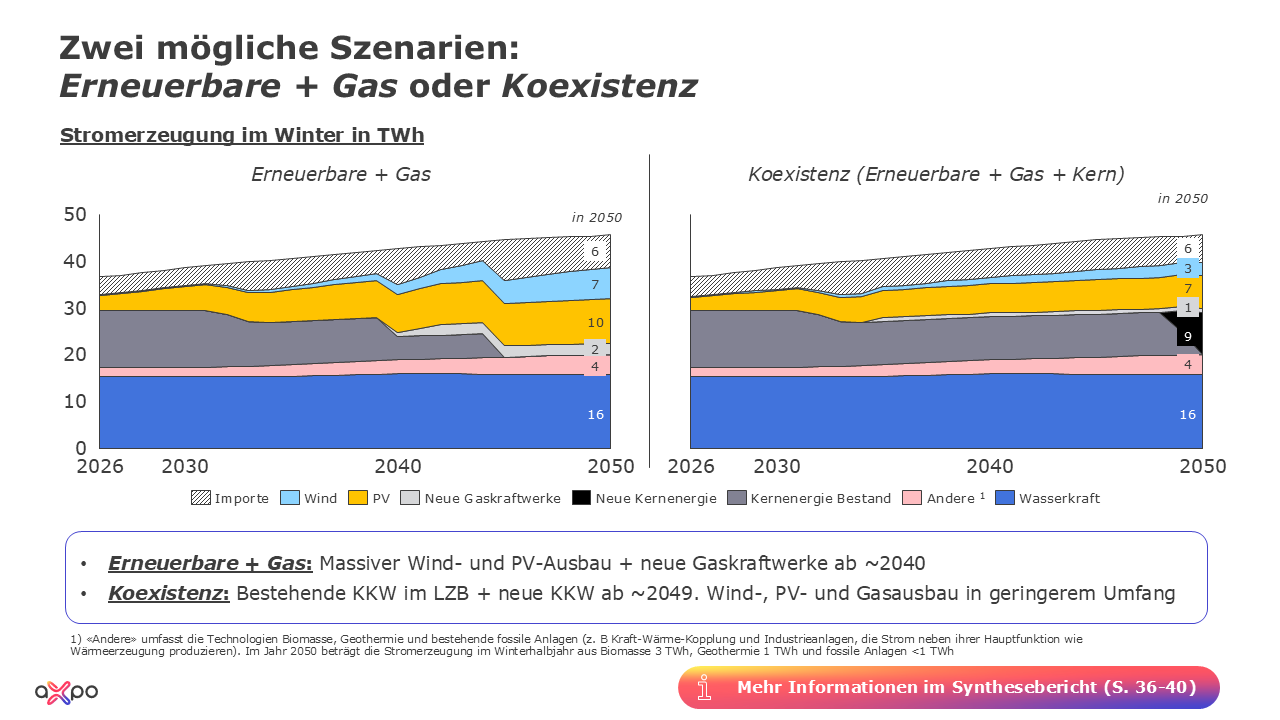
Scenario 1 consists of a balanced mix of hydropower, more photovoltaics, significantly more wind power, and a number of market-active gas-fired power stations as a flexible supplement. The latter meet the steadily growing demand for flexible generation resulting from the expansion of renewables to ensure winter supply, especially during critical weather conditions.
In Scenario 2, Switzerland opts to build two new nuclear power plants. These work alongside other technologies, including hydropower, more photovoltaics, more wind power and flexible, market-responsive gas-fired power stations. However, new nuclear power plants would significantly reduce the need for expansion in all other technologies.
“No-regret” moves needed now, regardless of scenario
Whatever energy path Switzerland ultimately takes, Axpo recommends specific measures that would be worthwhile under any future scenario. These are “no-regret” moves in the following key areas:
Implementation of appropriate regulatory measures to reduce political, regulatory and financial risks by ensuring the continued operation of existing nuclear power plants. This would be the most cost-effective option for large volumes of winter energy, giving Switzerland time to expand other technologies. It would also create the possibility at a later date of incorporating technologies that are unavailable today. Given the technical decisions required in just a few years’ time, this measure demands a high sense of urgency. In the interests of being open-minded about all technologies, Axpo also supports lifting the ban on the construction of new nuclear power plants.
Structural adjustment of the subsidy regime towards technology-neutral, transparent and efficient support for winter electricity. Currently, subsidies are not being used efficiently enough and primarily result in the expansion of summer electricity production. However, the primary challenge lies in winter.
Accelerated expansion of wind power: Switzerland has significant wind energy potential, although each site must be assessed individually as uncertainties exist due to the country’s specific topography. Wind is particularly cost-effective for generating winter electricity. To harness this potential, the acceleration must be implemented consistently and swiftly at cantonal level.
Creation of suitable framework conditions for flexible market-active gas-fired power stations (in particular waste heat utilisation, no double taxation of CO2). Gas-fired power stations are necessary to secure Switzerland’s future energy supply, but they emit CO2. Various solutions are under consideration in the long term for the low-emission operation of gas-fired power stations. However, as matters stand today, these are still associated with significant uncertainties regarding availability and cost. The number of gas-fired power stations required depends on the operating life of existing nuclear power stations, the pace of expansion of other technologies, and the development of electricity demand. Once the framework conditions are in place, gas-fired power stations can be built within a few years. They can contribute more or less power to the electricity supply in a flexible manner, tailored to demand.
Unless these measures are implanted, the only options remaining will be reserve power stations built at short notice – in the worst case under emergency legislation – and rising electricity imports.
Axpo conclusions
Following completion of the “Axpo Energy Reports”, developed in collaboration with external institutions and the project advisory board, Axpo has considered the findings and drawn its own conclusions:
Scenario 1 makes sense, provided Switzerland significantly expands wind power, enables gas-fired power stations, and continues the long-term operation of existing nuclear power plants.
For this scenario to become a reality, two factors are essential. The pace of wind power expansion must increase significantly, while the necessary framework conditions must be set for the long-term operation of nuclear and gas-fired power plants. From Axpo’s perspective as a company, this scenario allows for reduced state involvement and greater reliance on market-based mechanisms. It also offers greater flexibility for long-term technological developments. As the additional CO2 emissions from gas-fired power stations remain negligible within the overall picture of Switzerland’s CO2 balance in 2050, this scenario is most in line with the decisions taken to date by the electorate.
Scenario 2 with new nuclear power plants is worth considering, but is not a priority for Axpo as a company.
Given acceptance and implementation issues, it is uncertain whether the expansion of wind farms and gas-fired power stations can succeed as required.
Therefore, to keep all options open, the path to Scenario 2 should be prepared in parallel. To enable this, suitable framework conditions for new nuclear power plants would first need to be established. A preliminary step would be to lift the ban on new construction, which Axpo strongly supports.
As a company, however, due to unresolved political, regulatory and financial risks, this second path is not a priority for Axpo. Unless the state comprehensively assumes those risks, undertaking the development of new nuclear power plants would be unsustainable for any company. Indeed, it is unclear whether such risk assumption would be politically feasible for any government, whereas the broader risk sharing in Scenario 1 tends to facilitate political implementation. However, should the electorate opt for a scenario involving new nuclear power plants and comprehensive risk assumption by the state, Axpo stands ready to support the implementation of this scenario to the best of its ability – provided its owners agree.
“Axpo Energy Reports” contribute to debate
Axpo has adopted an open-minded approach to technology and outcomes in the preparation of these reports. In addition to its key role in hydropower, the company has extensive experience in all the technologies examined. Axpo is currently constructing its 100th wind farm in Europe, while in the natural gas sector it actively contributes to the stability of energy markets and the transformation of the European energy system, also owning and operating gas-fired power stations outside Switzerland. Nuclear energy has been part of Axpo’s portfolio for decades and provides reliable, low-emission electricity. Axpo is also well-versed in solar power through its subsidiaries CKW in Switzerland and Urbasolar in other European countries.
In publishing these reports on www.axpo.com/energy-reports, Axpo is making this solid knowledge base available to all interested parties. Following the Axpo Power Switcher, this is a further contribution to an urgently needed debate on the future of Switzerland’s energy supply. The findings aim to support society, politicians and the industry in making decisions about the expansion of domestic electricity production. The reports will be presented and discussed today at an industry event in Zurich.
The “Axpo Energy Reports” can be found at: www.axpo.com/energy-reports
- News release in English View Send email Download
- News release in German View Send email Download
- News release in French View Send email Download
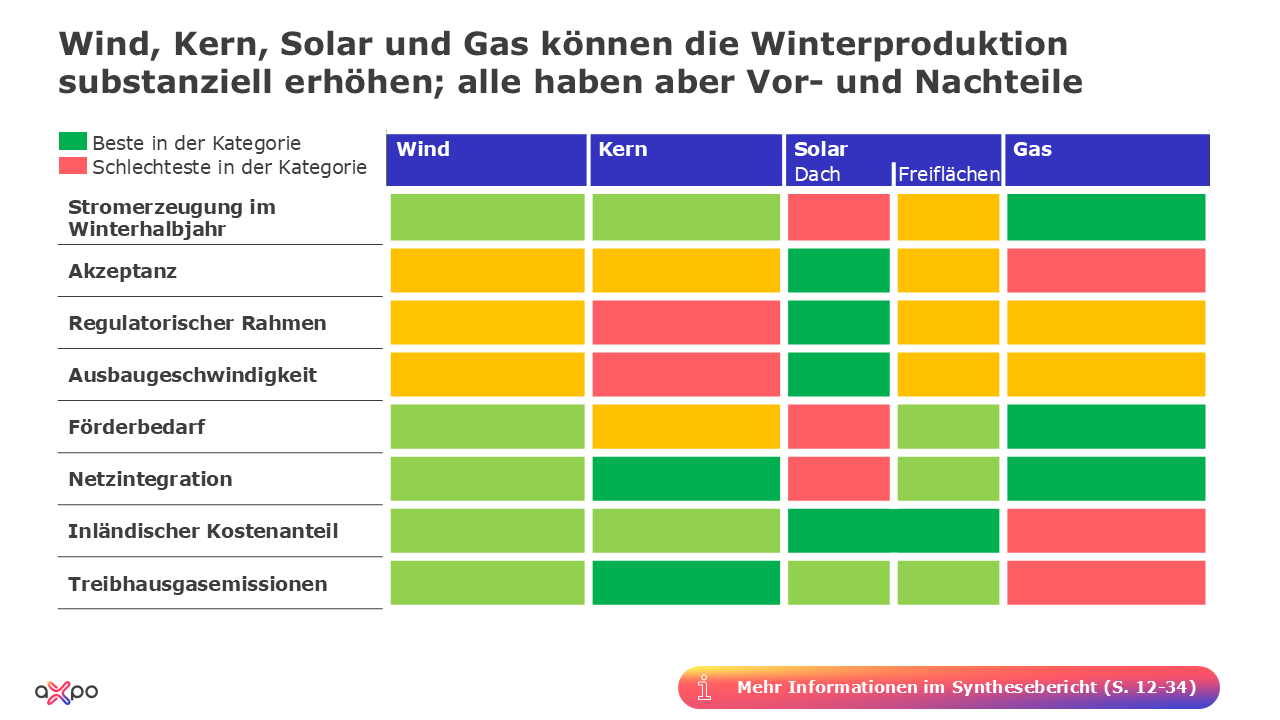
- Figure 1: Advantages and disadvantages of wind, nuclear, solar and gas Send email Download
- Figure 2: Comparison of scenarios Send email Download
Axpo Holding AG
Corporate Communications