



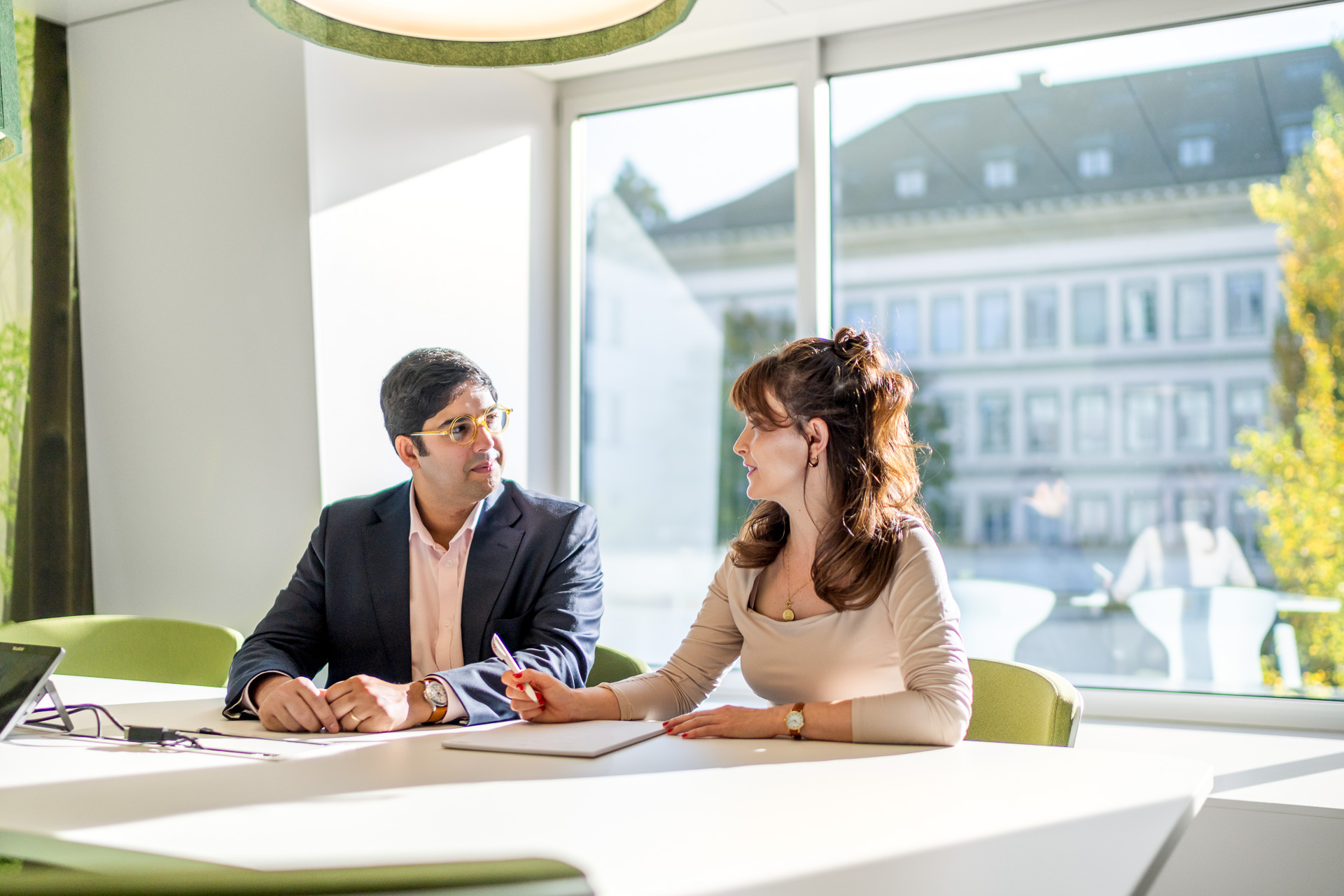

Intern Digital Nuclear Power Plants Interview with Justus Schilling
How has your professional path gone so far and which stations have been particularly formative for you?
Due to my interest in really getting to the bottom of relationships, I decided to study mathematics and quickly realized that my passion is less for pure theory than for its practical application. I gained my first practical experience as a working student at a German automotive supplier in the field of predictive maintenance. There I learned how statistical models and machine learning methods can be used in an industrial environment.
Through my master's thesis, I was then drawn to the medical field. In a research project on the prediction of cardiac arrhythmias, I was able to contribute and further deepen my statistical knowledge.
In June 2026, I started at Axpo as an intern in Packaging Optimization. This station is particularly formative for me because it allows me to combine my previous experience in industry and research with a new, challenging field of application.
What tasks and projects were you entrusted with during your internship?
In essence, the aim was to fill containers as optimally as possible with parts of any geometry. To do this, I have
• examined existing scientific and industrial approaches and adapted them to the specific application,
• developed a virtual simulation environment in which different methods can be systematically compared and evaluated,
• Use the environment to identify the best of the approaches and share the lessons learned with other teams to plan future processes more confidently.
Through 3D printed replicas of the parts and the container, I was able to simulate manual, intuitive human loading to compare it with the algorithmic process of the computer.
Why did you decide to do an internship in the field of digital transformation at Nuklear (KGD)?
The internship was simply a perfect fit for me. I was particularly attracted by the open problem and the associated challenge. KGD offers a technology-open and at the same time strongly practice-oriented environment, which is exactly the right environment to develop such a project from the idea to a resilient approach.
Thematically, there were several overlaps with my previous projects, especially with regard to algorithmic optimization. As a result, the internship was very well aligned with my interests and skills and offered a challenge that helped me professionally.
What competencies or skills were you able to develop in particular during the internship?
On the one hand, I was able to significantly sharpen my understanding of the algorithmic implementation of container loading and gain many practical insights, which are often lost as details in theory, but are crucial in practice.
On the other hand, I have further developed my skills in the development and structuring of Python codebases. Starting from the prototype, I was able to hand over a clean and maintainable project.
In addition, I gained a first insight into working in the nuclear environment and developed a better understanding of the special framework conditions and challenges that have to be taken into account there when planning and implementing technical solutions.
The final presentation was particularly valuable: it enabled me to bundle my findings, present them in a structured way and critically question them. This further sharpened my analytical and communication skills.
Would you choose to do an internship at KGD again – and why?
I would definitely choose an internship at KGD again. On the one hand, because the topics are extremely exciting and relevant: You work on issues that have the potential to help shape the future. On the other hand, I have experienced a very warm welcome in the team from day one. The combination of technically interesting challenges and an open, supportive environment makes the internship an experience for me that I would repeat at any time.