
.jpg)





Decommissioning of Beznau nuclear power plant
After extensive review work, Axpo decided on 4 December 2024 that Unit 2 of the Beznau Nuclear Power Plant (KKB) will remain on the grid until 2032 and Unit 1 until 2033. After that, they will be taken out of service and decommissioned. This decision was made taking into account the technical, organisational, regulatory and economic aspects.
Major contribution to security of supply
The Beznau nuclear power plant has been connected to the grid since 1969 and produces almost 6 terawatt hours of electricity per year safely and with low emissions, with a high proportion of winter. This corresponds to the consumption of 1.3 million four-person households. In this way, the plant and its employees will make an important contribution to security of supply in Switzerland until it is decommissioned.
Decommissioning with in-house staff
KKB employees are central to Axpo. Decommissioning and dismantling are carried out as far as possible with the company's own employees. In addition, additional recruitment and the commissioning of third parties will be necessary.
The decommissioning process
For the final decommissioning of a nuclear power plant, operators must draw up a decommissioning project and submit it to the Swiss Federal Office of Energy (SFOE). The SFOE coordinates the decommissioning procedure and obtains the opinions of various federal authorities, including in particular the ENSI, FOEN, ARE and cantonal authorities. If this assessment is successful, the responsible Department of the Environment, Transport, Energy and Communications (DETEC) issues the decommissioning order.
ENSI monitors not only the operation of the nuclear power plants, but also all decommissioning work from post-operation to completion of dismantling. The protection of the population, personnel and the environment is also guaranteed at all times during the decommissioning of nuclear power plants.
The decommissioning of nuclear power plants has been solved from a technical point of view and is carried out in proven and safe procedures. More than 200 plants have already been shut down worldwide. For specially required work, there are specialized companies with great experience.
of the dismantling material must be stored in Nagra's deep geological repository.
billion CHF will cost the decommissioning and disposal of the Beznau nuclear power plant.
Years after the start of the decommissioning, the site can be reused.
How does the decommissioning take place?
2024
Decision to decommission
2028
Axpo submits the decommissioning project for Beznau Nuclear Power Plant
2032
Beznau NPP shuts down Unit 2
2033
Beznau NPP shuts down Unit 1
Around 2036
Fuel assemblies are stored in the interim storage facility
Around 2043
Facility is no longer subject to Nuclear Energy Act
Around 2046
Decommissioning and dismantling are complete
The decommissioning will begin with the final cessation of power operation. During nuclear dismantling, the plant will be dismantled step by step until all radioactive material has been removed from the site and ENSI confirms that the plant is no longer a source of radiological hazards. The dismantling of the Beznau NPP will take until the mid-2040s. A precise schedule will be worked out with the decommissioning project. The site of the power plant site can then be reused.
From the inside out
Nuclear dismantling takes place from the inside out. First, the fuel assemblies are removed from the plant and packed in transport and storage containers. Since the Beznau nuclear power plant operates its own interim storage facility (Zwibez) at the site, there is no need for the usual transport to the central interim storage facility (Zwilag) in Würenlingen. Low- and intermediate-level industrial waste is also professionally packaged and largely taken to the Zwibez. A small proportion of the waste goes to Zwilag. When all the fuel elements from the nuclear power plant have been moved to the Zvivets after about four years, the most important source of radioactivity will also have been removed from the reactor building. Even at an early stage, systems and plant components are decommissioned or adapted to the new requirements.
During dismantling, the non-radioactive materials are sorted out and recycled or disposed of like conventional waste. Materials on which radioactive substances have been deposited are cleaned (decontaminated) and, after clearance measurement, are also recycled or disposed of as far as possible in the conventional ways.
Only a small part of the dismantling material is later transported to the deep geological repository of Nagra (National Cooperative for the Disposal of Radioactive Waste).
Ready for reuse
Once the facility is free of fuel elements and radioaktive waste, the authorities were able to officially determine that the KKB was no longer a source of radiological danger. The site of the former nuclear power plant will then be considered a normal industrial area and can continue to be used. The subsequent use is still open. The Zwibez will remain on the site until the waste is transported to the deep geological repository. Afterwards, the Zwibez will also be dismantled.
Financing
The financing of post-operation, decommissioning and disposal of radioactive waste is comprehensively regulated and secured by law in Switzerland. Axpo, as the operator of the KKB, bears all costs associated with post-operation, decommissioning and disposal. To this end, Axpo pays into two funds monitored by the federal government during operating hours: the decommissioning fund and the waste disposal fund. The post-operating costs for the period between the final cessation of power operation and the absence of nuclear fuel will be borne directly by Axpo.
Details on financing can be found on stenfo.ch.
FAQ
KKB 2 will be decommissioned in 2032 and KKB 1 in 2033.
No. Decommissioning and decommissioning planning require a period of time. Axpo's decision to take KKB 2032/33 off the grid is final.
Axpo, which operates the KKB, is responsible. It must develop and submit the decommissioning project and finance and carry out the dismantling. ENSI assesses nuclear safety and prepares a safety-related report; the decommissioning order is issued by the competent department (DETEC; The SFOE) is the lead executor.
The dismantling of the Beznau NPP will take until the mid-2040s. A precise schedule will be worked out with the decommissioning project.
The Beznau nuclear power plant meets the highest safety requirements. Axpo has invested over 2.5 billion Swiss francs in retrofitting and modernisation since it went into operation.
The employees at the Beznau NPP are indispensable for us – beyond ongoing operations. That is why we will also count on our own employees during decommissioning and dismantling.
After the shutdown, the fuel assemblies will initially remain in the fuel element storage pools at the Beznau site until they have sufficiently subsided. They are then temporarily stored in transport and storage containers in the Beznau ZWIBEZ interim storage facility until they are transported to the deep geological repository.
Radioactive material is collected and sorted after dismantling. After decontamination, a large part of the material is free of radioactivity and is returned to the conventional material cycle. A smaller part of the material is conditioned as radioactive waste and packed into containers suitable for deep geological storage. These will initially be stored temporarily and later stored in the deep geological repository. The radiologically relevant work is under the supervision of ENSI.
No. Well over 90% of the waste can be decontaminated and cleared. The aim is to minimise waste and to dispose of radiologically contaminated material professionally and safely.
The operator must prove that the site no longer poses a radiological hazard after the decommissioning has been completed. ENSI examines the safety-related aspects and monitors the decommissioning. Only when the legal requirements are met will the site of the Beznau nuclear power plant no longer be considered a nuclear plant.
A decision on the subsequent use of the area will be made independently of the closure and at a later date.
The decision has no direct impact on Swiss electricity prices. The plant will continue to produce reliable low-CO2 electricity for a long time to come.
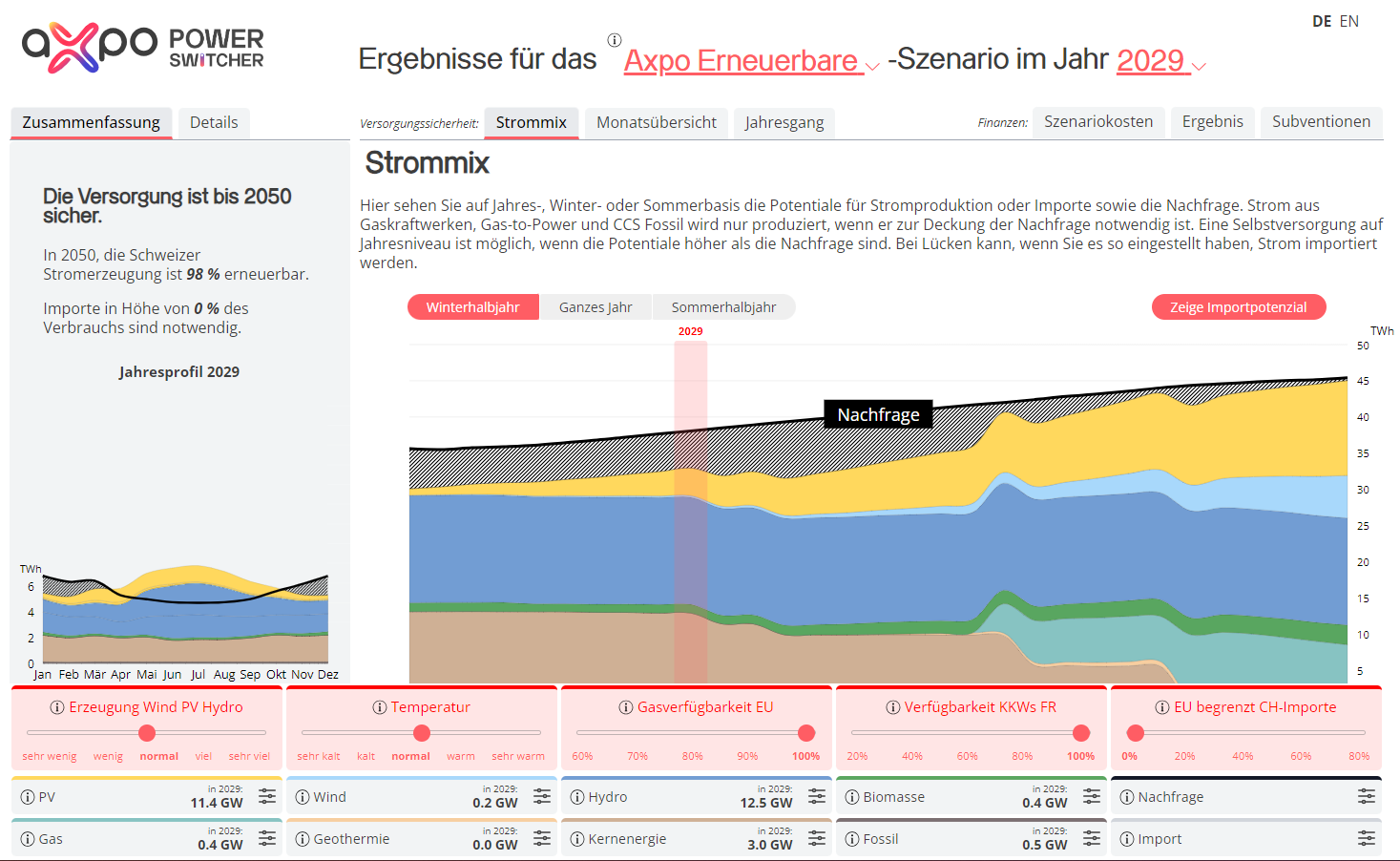
Axpo has dealt intensively with the question of the future electricity mix and published the Axpo Energy Reports in 2026. Here you can find more information:
Experience from the Mühleberg nuclear power plant
How the dismantling in Mühleberg is proceeding can be read here at BKW.