
.jpg)





Axpo Energy Reports: Gas Energy
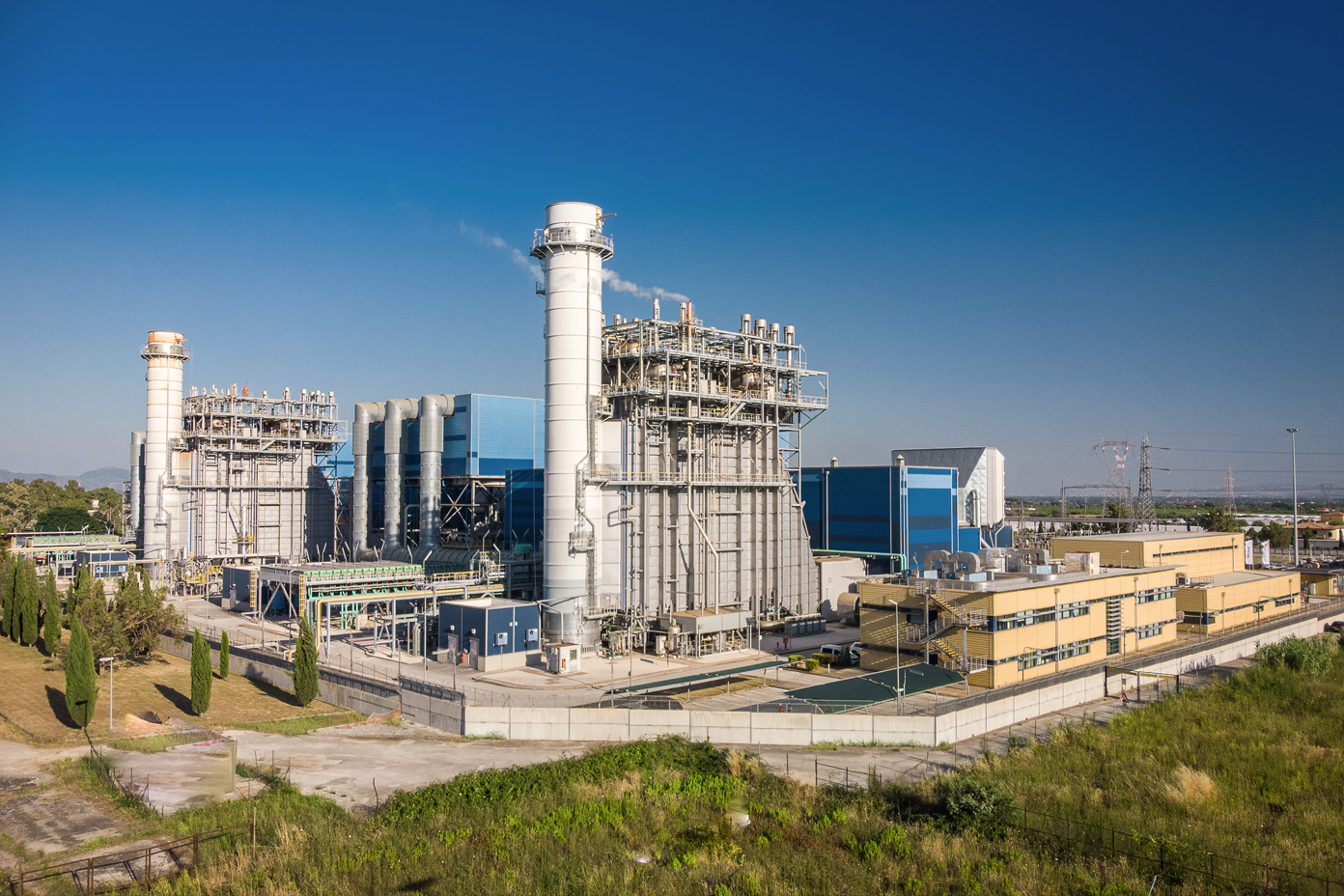
Gas‑fired power plants can be operated very flexibly and can generate electricity exactly when it is needed – especially in winter or during periods with little sun and wind. This makes them a suitable complement to renewable energy sources whose production depends on weather conditions.
Low‑emission operation based on renewable gases is technically possible, but currently expensive and limited by the availability of these fuels. In many European countries, gas power plants therefore serve as a transitional solution, with a long‑term shift toward climate‑neutral alternatives being the goal. In Switzerland, current legal requirements make economic operation more difficult, for example due to additional levies or the absence of support mechanisms. The Energy Reports outline the framework conditions that would be necessary for gas power plants to contribute to security of supply – without making a recommendation for or against their use.

Key questions and answers
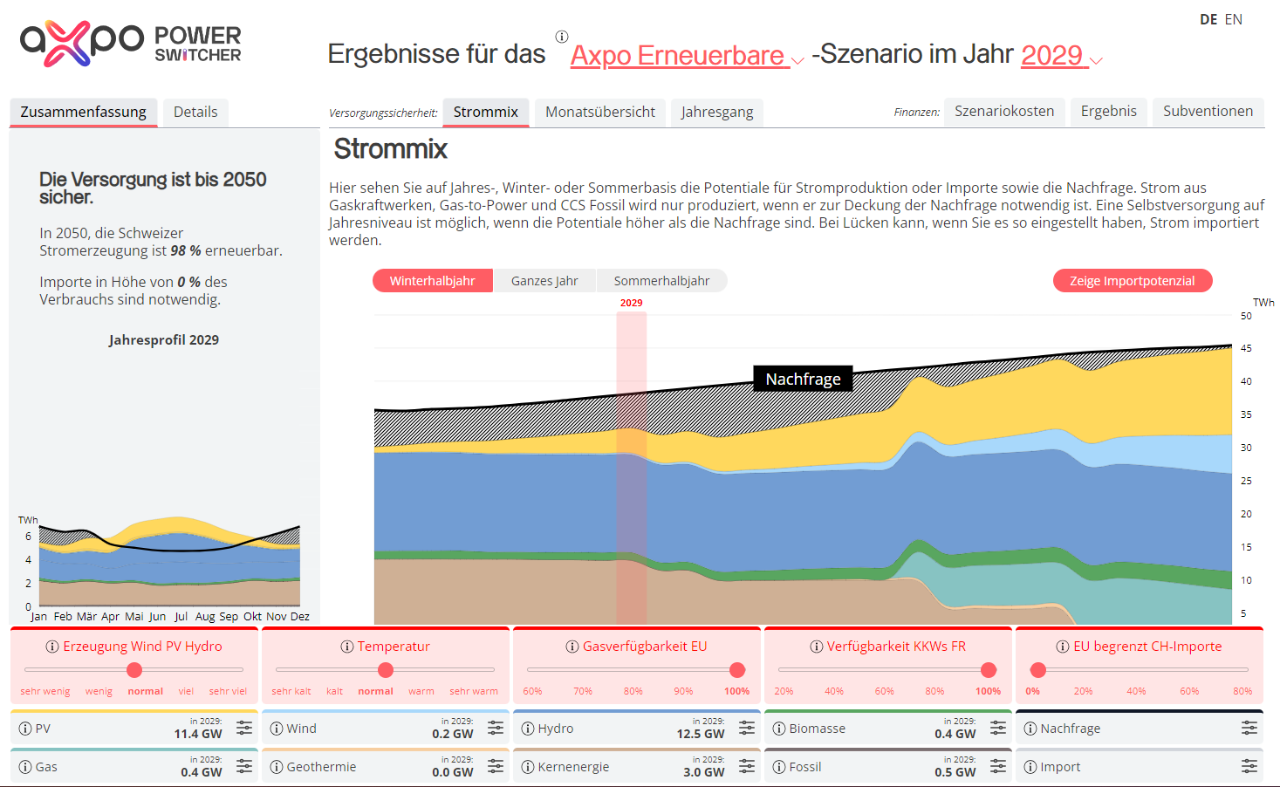
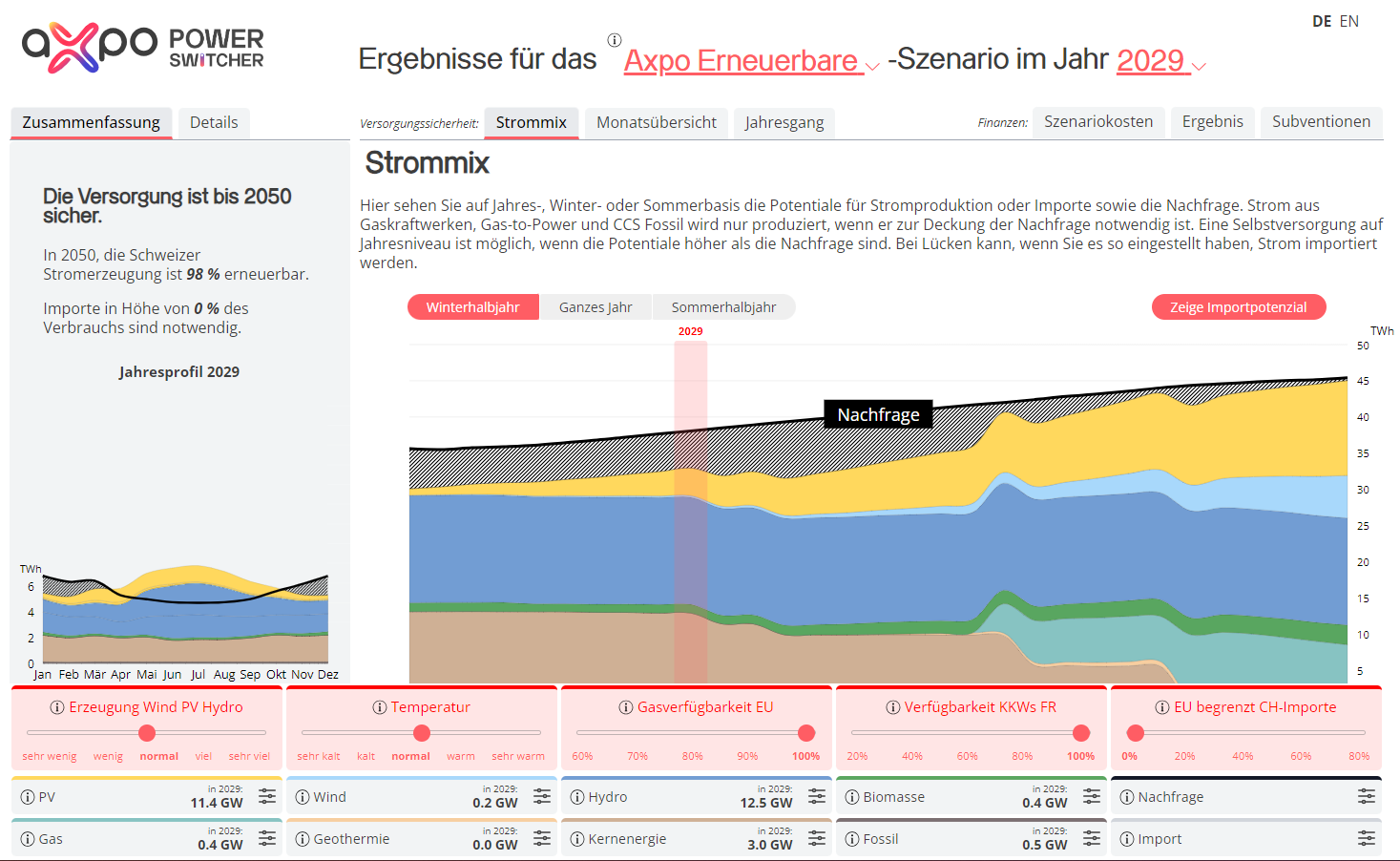
There are currently no large, commercially active gas-fired power stations in Switzerland, even though they could provide flexible electricity supply in winter. The Axpo Energy Reports highlight the conditions under which gas-fired power stations could make a contribution by 2050.
Gas-fired power stations would be technically feasible and suitable sites are available. However, they require specific regulatory adjustments: removing the double CO2 tax, adapting cantonal waste heat regulations, and introducing support mechanisms. Measured in terms of ‘subsidy francs per MWh of winter electricity’, efficient, market-responsive gas-fired power stations would be a comparatively very cost-effective solution to closing the looming winter electricity gap. In the medium term, gas-fired power stations would be fuelled by natural gas and would therefore emit CO2. For low-emission operation of gas-fired power stations in the long term, various solutions are under consideration, such as operation using hydrogen or with CO2 capture and storage; however, as things stand today, these are still associated with significant uncertainties regarding availability and costs.
Flexible gas-fired power stations can step in at short notice to meet demand when electricity demand is high in winter, domestic generation is insufficient to cover it (low water levels in reservoirs, power station outages), and electricity imports are expensive. In this way, they complement fluctuating electricity generation from renewable energy sources as well as flexible but energy-limited pumped-storage hydroelectric power stations, thereby enhancing security of supply in tight winter situations.
Once the framework conditions are in place, gas-fired power stations can be built within a few years. They can contribute more or less to the electricity supply in a flexible and demand-driven manner – depending on the operating life of existing nuclear power stations, the pace of expansion of other technologies, and the development of electricity demand.
According to Axpo’s scenarios, gas-fired power stations are necessary to secure Switzerland’s future energy supply, but they do emit CO2. However, even with gas-fired power stations, we anticipate a significant reduction in Switzerland’s CO2 emissions. The main driver is the widespread electrification of heating, transport and industry, which enables substantial decarbonisation. The additional emissions from gas-fired power stations are relatively small compared to existing and future emissions. According to the ‘Long-term Climate Strategy 2050’, annual CO2 emissions will fall from 40 Mt CO2 today to 12 Mt CO2 by 2050; with gas-fired power stations in the ‘Renewables + Gas’ scenario, this figure would be 1 Mt higher. Gas-fired power stations therefore serve a broader decarbonisation framework: those who switch their transport or heating to electricity are supported by highly efficient gas-fired power stations. According to the climate strategy, the remaining emissions will be offset by negative emission technologies both domestically and abroad.
Market-active gas-fired power stations participate regularly in the electricity market. They generate ongoing revenue from the sale of electricity, which enables them to cover a significant portion of their costs. Consequently, their need for financial support is lower than that of pure reserve power stations. Furthermore, they reduce the need for imports, as they supply electricity when market prices send the appropriate signals. In situations of scarcity, they help to dampen sharp price fluctuations by increasing the available supply in the market. The downside of market-active gas-fired power stations is that – at least in the medium term – they are fuelled by fossil natural gas and thus lead to higher domestic CO₂ emissions.
Reserve power stations, on the other hand, are maintained exclusively for short-term supply shortages (when the market no longer closes) and rare situations of scarcity. They do not normally operate. They therefore generate no market revenue and must consequently be financed entirely through state support. Their contribution to emissions is generally less significant due to their short operating times. Low-carbon designs (e.g. the use of low-emission fuels) can increase the likelihood of obtaining permits and enhance social acceptance. From an economic perspective, however, the cost-benefit ratio of low-carbon operation for reserve power plants is unfavourable, as this involves significant additional investment, whilst the plants rarely actually generate electricity and emit emissions anyway.
To date, gas-fired power stations have played a minor role in Switzerland: in 2023, around 0.7 TWh of electricity was generated using natural gas and biogas. Electricity production takes place predominantly in combined heat and power (CHP) plants, mostly decentralised plants with an electrical output of a few MW. These plants primarily provide heat for industrial processes or district heating networks; the electricity is a by-product of this process. Furthermore, these plants involve high investment costs per MW and are difficult to scale.
Market-active gas-fired power stations, on the other hand, are particularly suitable where electricity demand is the priority and flexible, demand-driven electricity generation is required. Although their efficiency of around 60% is lower than that of CHP plants (over 80%), the value of the electricity generated is higher than in CHP plants, which supply both heat and electricity. Further heat extraction is practically impossible for market-responsive gas-fired power stations, as there are generally no suitable large and flexible heat consumers available. However, this would need to be assessed on a case-by-case basis.